
Sherwani for Groom in Canada
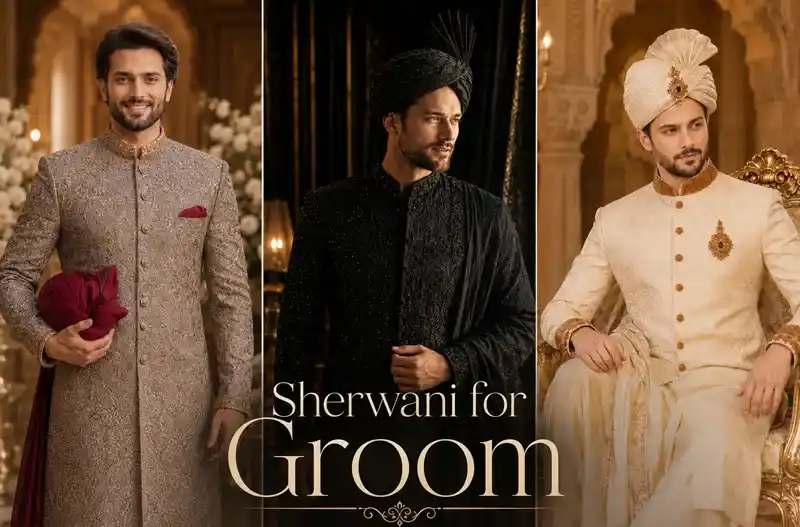
This collection holds seven sherwanis in grey, beige, black, cream, gold, white and ivory: the long, structured coat South Asian men wear for weddings and formal celebrations.
Every sherwani for men here is made to order rather than taken from finished stock, and each is cut with a high band collar and fully lined. Most are designed with the groom in mind, though the quieter pieces sit comfortably on brothers, fathers and close wedding guests.
What separates them is the surface work. Embroidery ranges from black-on-black tonal thread that only shows as the light moves, to gold zari set at the collar and cuffs. Open any product for its fabric, embroidery and measurements before choosing.
Showing all 10 resultsSorted by latest
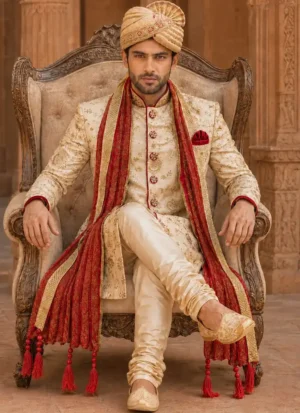
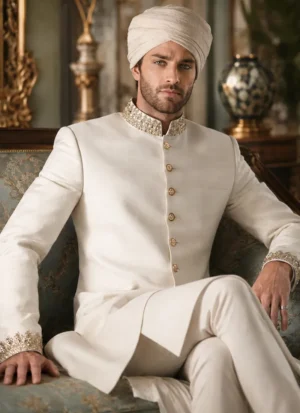
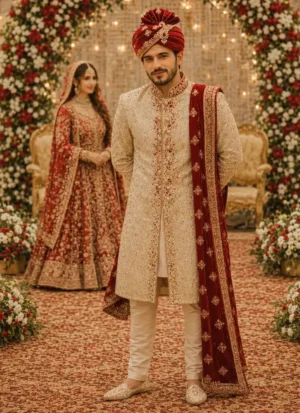
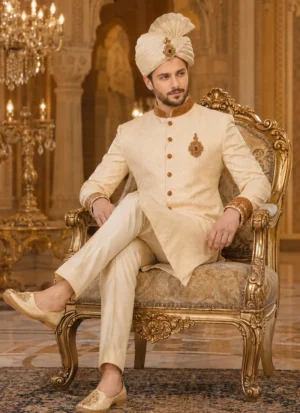


Showing all 10 resultsSorted by latest
Choosing a sherwani for a wedding
A South Asian wedding runs across several events, and the sherwani usually does its heaviest work at the baraat or the main reception, where the groom is photographed most. A nikah tends to call for something calmer. An evening walima or reception carries a more embellished piece well.
Two questions settle most of the decision.
The first is how much attention the coat should draw. A gold-dominant sherwani with red accents holds its own beside a heavily worked bridal outfit; a tonal grey or beige coat deliberately does not, and lets the bride lead the photographs.
The second is whether this is a garment for one event or several. Restrained tonal embroidery reads as formalwear and can be worn again at a family wedding. A gold sherwani with red detailing is far harder to repeat without it being recognised.
Because each piece is made to order, both questions are worth settling before the order goes in rather than after.
Styles and construction across the collection
All seven follow the same basic template: a long coat with a high stand collar, fully lined, closing at the centre front. The cloth across the collection is Silk Jamawar. On the cream sherwani that fabric is self-patterned, so the base carries its own tonal design before any embroidery is added.
The amount of embroidery varies sharply from one piece to the next.
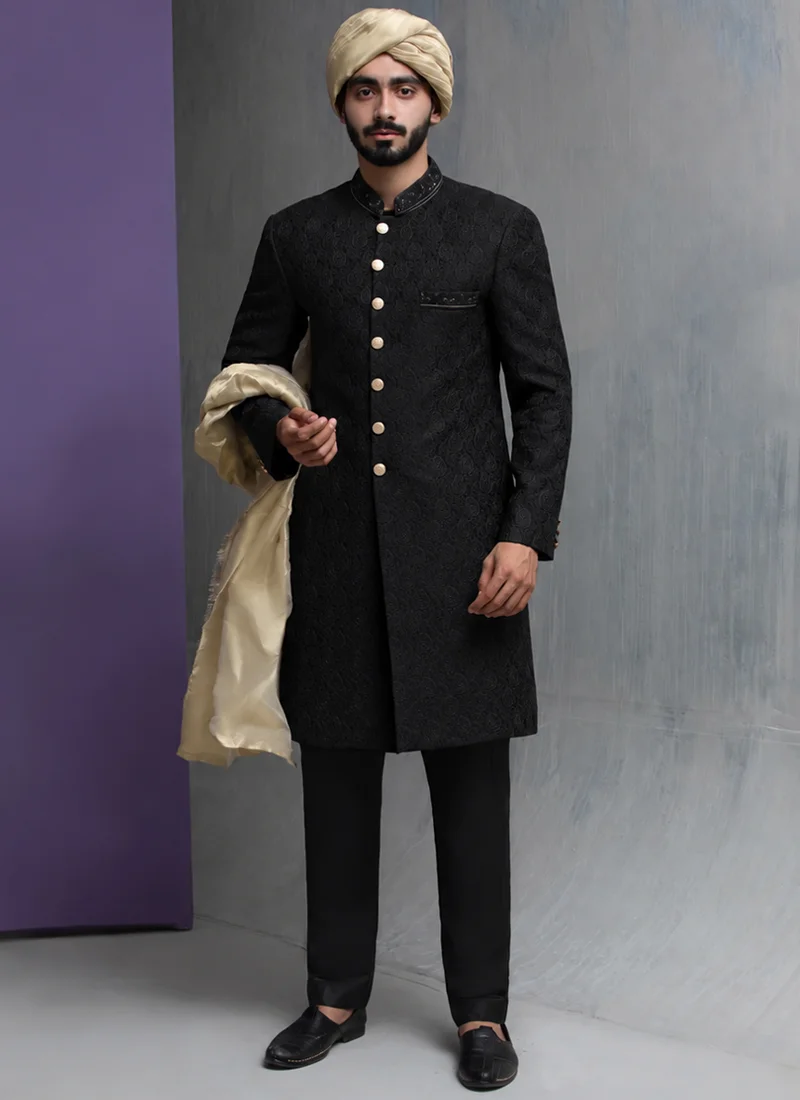
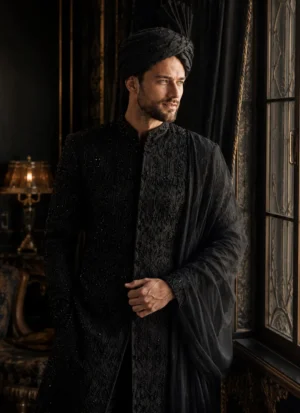
The black sherwani is worked black-on-black, so the pattern appears only as the light moves across it. The grey and beige are similarly tonal, embroidered in shades close to the base cloth. The grey is finished with large embellished front buttons; the beige keeps a clean front without prominent buttons, which is a genuine difference in how formal each one reads. The golden sherwani sits at the opposite end, gold-on-gold with deep red accents at the collar, centre front and cuffs.
Gold zari is used on three of the seven, and only in specific places: at the collar and cuffs on the cream sherwani, at the collar alone on the white, and at the high band collar on the ivory. Gold thread embroidery elsewhere on a garment is a different technique, and each product page states which is which rather than treating the two as interchangeable.
The work on every sherwani in this collection combines hand embellishment with machine embroidery. None is produced entirely by hand.
Choosing a sherwani colour
Three of the seven colours — white, cream and ivory — are close enough that they are worth separating before choosing.
White is the coolest and cleanest of the three, and here it is also the plainest: an unembroidered body with hand-worked gold zari at the collar and decorative gold borders at the cuffs. Cream is warmer, with a self-patterned base, gold thread embroidery, zari at the collar and cuffs, and a single motif at the upper chest. Ivory carries the most gold of the three, with embroidery across the garment and deep red stitched into the front opening and cuffs.
Beige and grey are the restrained options. Both are embroidered tonally, so from any distance they read as texture rather than pattern. That suits a groom who would rather not compete with the bridal outfit, and a guest who should not.
Black is the strongest formal choice and the easiest to wear beyond a wedding. Gold is the opposite: the most photographed and the least repeatable, and the piece that carries the traditional baraat look most directly.
One practical note on all seven. Venue lighting shifts the light shades noticeably. Warm indoor lighting pulls cream and ivory towards gold, while daylight separates them clearly. If the ceremony and the reception are lit differently, the garment will not look identical in both sets of photographs.
Pakistani sherwani styling for grooms and wedding celebrations
The sherwani is standard groom wear at Pakistani weddings and is widely worn at Indian and other South Asian ones, usually over a kurta and fitted trousers. Pakistani styling tends towards a longer, straighter coat with embroidery concentrated at the collar, front opening and cuffs rather than scattered across the body. That is the cut this collection follows.
Guests wear sherwanis to these weddings too, generally in the quieter colours, leaving the heaviest gold work to the groom. If you are dressing for someone else’s wedding, the beige, grey and black pieces are the safer end of this collection.
Length, fit and ordering
Each sherwani is made to order rather than stocked in finished sizes. Length runs up to approximately 47 inches (about 119 cm). Both units are listed because Canada is a mixed-unit market, and the figures are quoted rather than silently converted, since production works in inches.
Size and measurement options are set per product, so check them on the individual product page before ordering.
Production and delivery: Every sherwani is made to order. Standard delivery is free and takes up to 3 months. Rush takes up to 30 calendar days for CAD $59, and Super Rush takes up to 14 calendar days for CAD $199. Each timeline counts calendar days from the day after you order and covers production and shipping. Shawls, turbans and other add-ons follow the sherwani’s timeline.
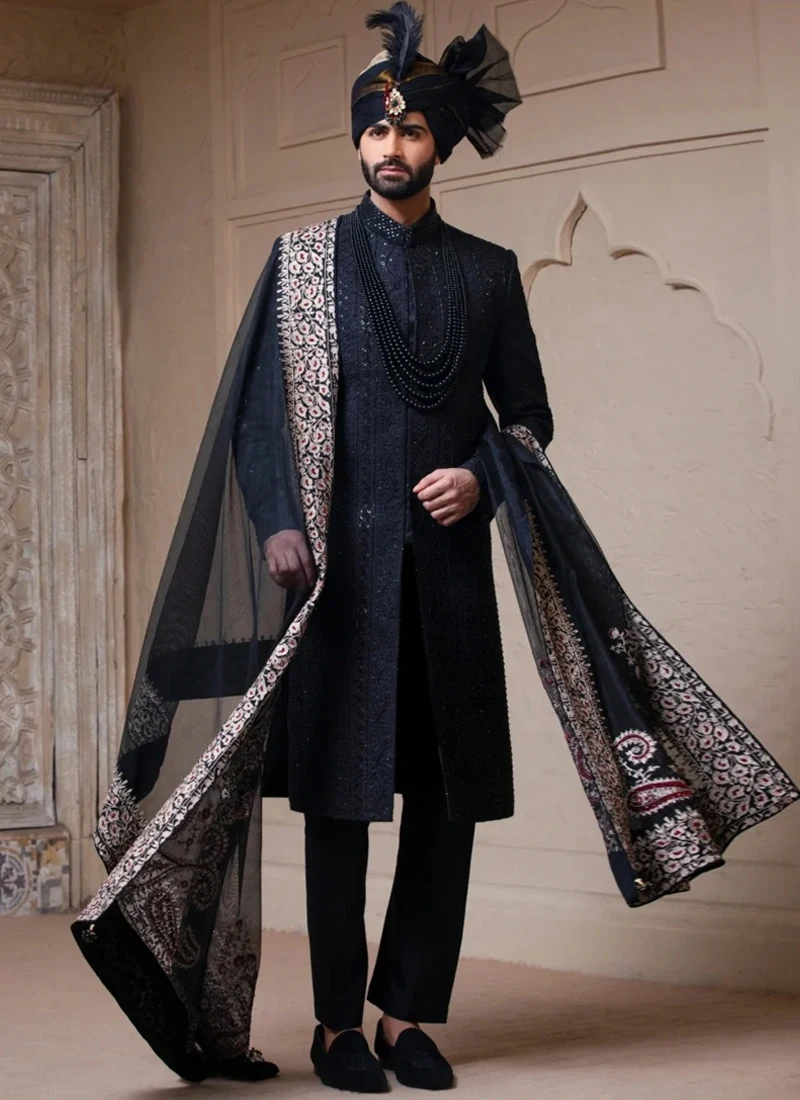
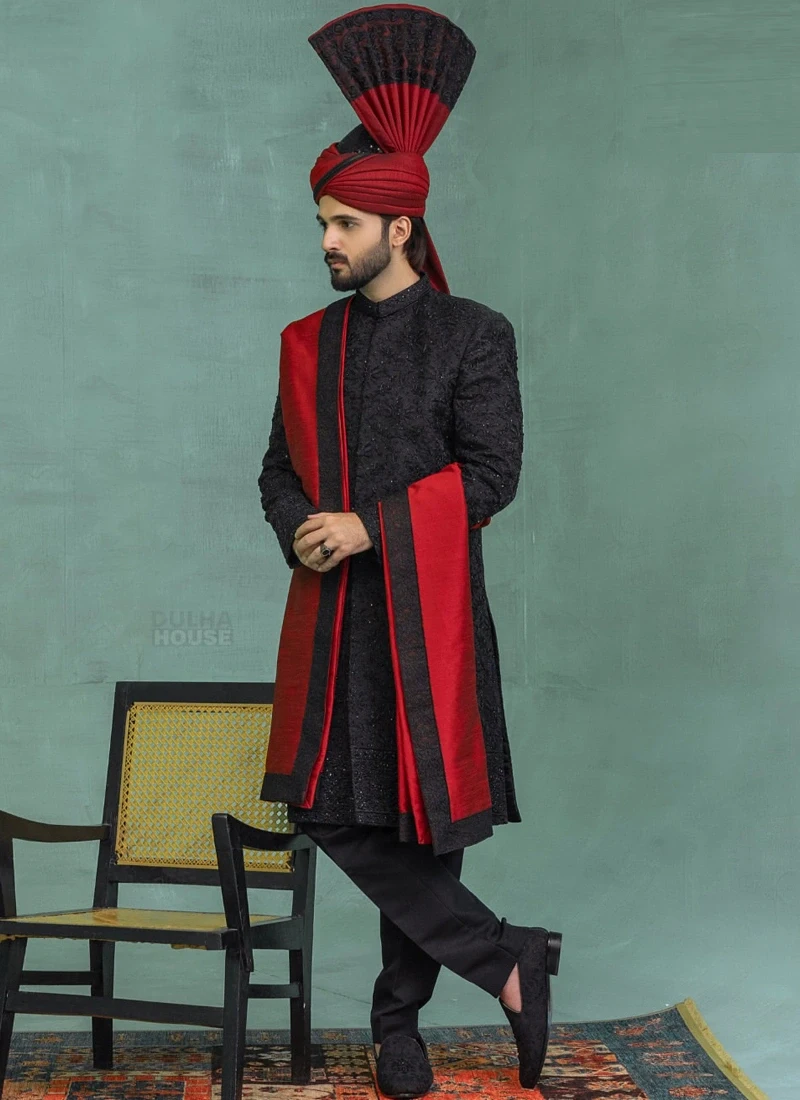
Items styled alongside a sherwani in photographs, including shawls, jewellery and footwear, are not part of the listing unless the product page states otherwise.
Frequently asked questions
What is a sherwani?
A sherwani is a long, structured coat worn by men across South Asia for weddings and formal occasions. It is cut to knee length or below, usually with a high stand collar and a centre-front opening, and is worn over a kurta and fitted trousers. It is the standard formal alternative to a Western suit at Pakistani and Indian weddings.
What is the difference between a groom’s sherwani and one worn by a guest?
Cut and construction are largely the same. The difference is the weight of the surface work. A groom’s sherwani carries heavier embroidery, stronger colour and more embellishment, because he is the focus of the photographs. Guests generally choose tonal or restrained pieces so they do not compete with the wedding party.
What colour sherwani should a groom wear?
There is no single rule, and it depends on the event and on the bridal outfit. Gold and ivory carry the most traditional baraat associations and photograph strongly. Cream and white read lighter and more formal. Black, grey and beige are the restrained choices and are the easiest to wear again afterwards.
What is worn with a sherwani?
A kurta and fitted trousers underneath, most commonly. Grooms often add a shawl or dupatta, a turban or safa, and formal footwear such as khussa or mojari. None of these are included with the sherwanis in this collection unless the individual product page lists them.
Is gold embroidery the same as zari?
No. Zari is metallic thread work and is a distinct technique from gold-coloured thread embroidery. In this collection, zari is used on three pieces only, and only at specified places on the garment. Each product page states which technique is used and where, rather than describing all gold work as zari.
Are these sherwanis entirely hand embroidered?
No. Every piece combines hand embellishment with machine embroidery. The balance varies by product, and the product pages describe which elements are hand-worked. Any listing anywhere claiming a fully hand-embroidered sherwani at this kind of price point is worth questioning.
What does made to order mean?
The garment is produced after the order is placed rather than shipped from finished stock. That allows the piece to be made to the size selected, but it means the timeline matters. If you are ordering against a fixed wedding date, confirm the production and delivery window before you place the order.